


The Mobile Planning Commission recommended the City Council deny the request by Food Pak owners to rezone their lot at 5070 Old Shell Road from residential to commercial at the meeting on Thursday, September 17th at 2:00pm.

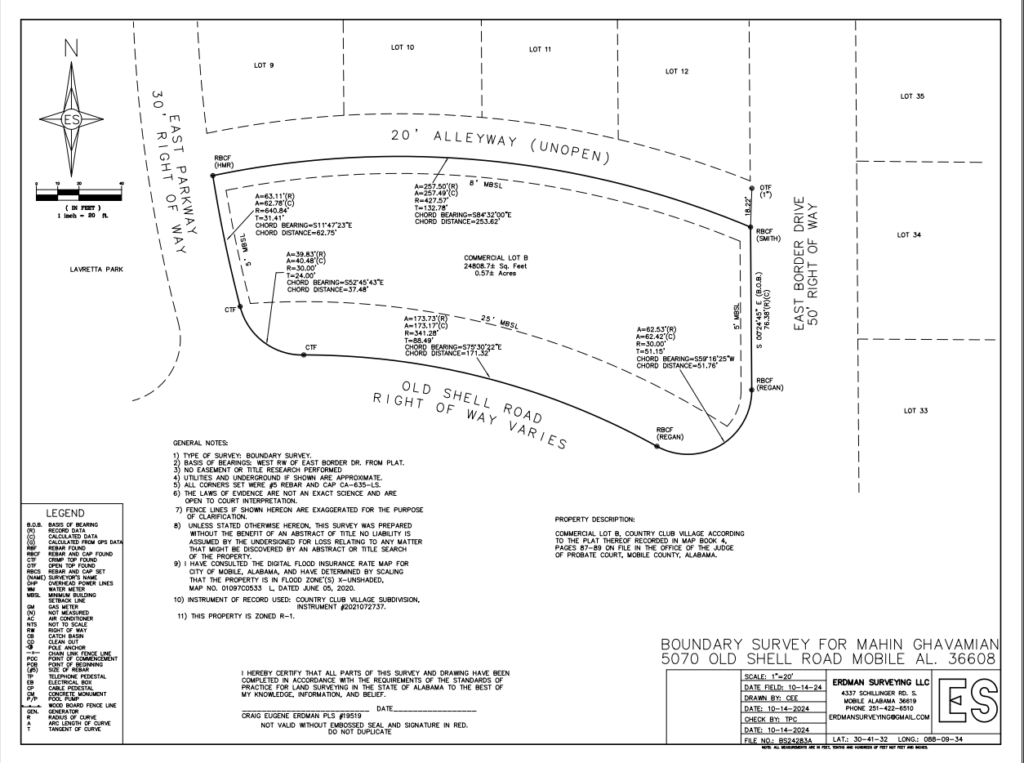
Owners of Food Pak International Foods, Mahin and Reza Hejazi, requested a rezoning on their wooded lot between Lavretta Park and Maple Street Biscuit Company from R-1, Single-Family Residential, to B-2, Neighborhood Business Suburban so they could build a new location as their landlord forces them to move out of their current building after 35 years in the community.

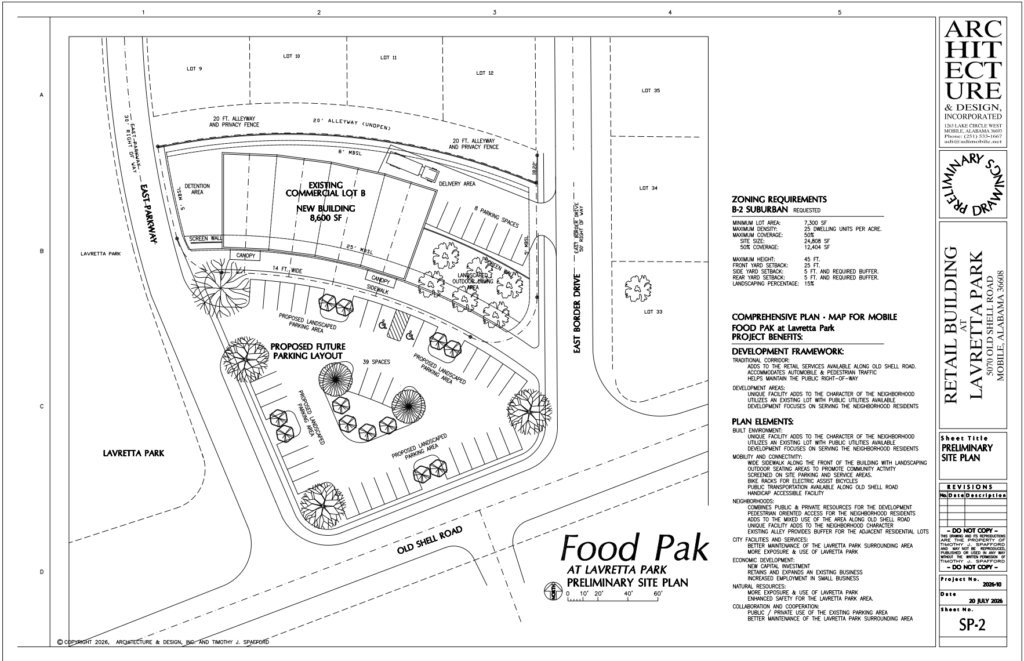
Project designer, Timothy Spafford, explained that a B-2 zoning is required to operate a grocery store. Beside the lot, Maple Street Biscuit Company was ‘grandfathered in’ and allowed to operate despite its residential zoning.
One main argument for the rezoning was its initial listing as a ‘Commercial Lot’ in 1943. “The main reason we’re asking for a rezoning is we believe it’s a mistake,” said Spafford. The adoption of the Zoning Ordinance in 1967 resulted in a residential zoning of the property. One speaker in support of the rezoning agreed: “The more you look at the area there – it makes sense. You’ve got commercial on the East, commercial on the park, commercial on the West.”
A previous contention with the site plan was the building’s proposed size at 8,600 square feet. Spafford explained at the meeting that the size was reduced to 6,500 square feet.

Mahin submitted the request to “adapt to the changing neighborhood demand without changing character of the surrounding area”. She said, “This project will transform an underutilized property into community asset . . . We want to be good neighbors and responsible partners in this town’s growth.”
Not all members of the community shared this view, like Linda St. John, President of Village of Spring Hill. She expressed concern for the long-term repercussions of a zoning change: “The established future of our community should be guided by planned, created by the community, not be taken by developers . . . or compromises to accommodate projects that do not belong.” She also voiced concerns about negative impact to adjacent property owners and argued that the rezone was not justified by a “landlord-tenant dispute”.
City Planning Commission member Kenny Nichols agreed with St. John. “The decision of this commission is not whether a landlord-tenant dispute is fair and just or frankly if a business has an inherent right to locate in close proximity to somewhere its been in the past,” he said. “There’s not been any commercial development, new buildings constructed, anything in a half mile of this site in my lifetime.”
A survey by the Planning Commission found that residents closest to the property mostly opposed the rezoning. “By my math, 87% of those living in 1400 feet [of the property] are in opposition to this rezone,” said Nichols.

While Spafford assured that all city requirements could have been met on the property without variance requests, commonly-voiced concerns in opposition focused on logistics of the plan. Some issues included an increase in traffic congestion posing a risk to pedestrians, delivery trucks’ ability to navigate the neighborhood, and potential flooding from improper storm water drainage.
Those in support of the rezoning were frustrated that the local business would be forced out. “This is a very unique place. We need to keep it there. This is part of the neighborhood,” one resident said. “I’m just one of 5,000 people who want to keep them [Food Pak] where they are now.”

There has also been an argument for Food Pak as a center of culture in the community. “We are a part of Mobile, and our different cultures, traditions, and small businesses are a part of what makes this city special,” one speaker said.
“I feel like the city has in its power the ability to make special dispensations for things that are bordering on, you know, city monument level or part of a culture of the city,” said resident Dylan Hendrix. “What do you want our city to look like? Do you want it to be nothing but chain restaurants on Airport Boulevard . . . or do you want there to be walkable communities?”